AI Memory Shortage 2026: RAM, SSD Prices Explained
Samsung's record $80B quarter proves AI data centres are eating the world's memory. What it means for your next RAM, SSD or laptop purchase — and what to buy.
Key Takeaways
- Samsung's Q3 2026 operating profit hit a record 107.4 trillion won (~$80B), almost entirely from chips — memory revenue alone surged 427% year on year.
- Samsung says its 2027 high-bandwidth memory supply is already sold out, and that the memory shortage will deepen next year — SK Hynix gave the same warning.
- TrendForce forecasts Q4 2026 contract prices up 10–15% for DRAM and 15–20% for NAND, but contract prices are not shop prices — they reach shelves later and unevenly.
- RAM and SSDs may split in 2027: DRAM is expected to stay tight, while NAND supply could ease in the second half of the year as new capacity arrives.
- Practical rule: buy the RAM you will need for the device's whole life now, especially in laptops where it cannot be upgraded later; SSDs are easier to add later.
- No forecast here is a promise — every 2027 price claim in this article is labelled as a forecast, and memory markets have crashed before.
Samsung just posted the biggest quarterly profit in its history — and your next laptop is competing with the reason why.
On 29 October 2026, Samsung Electronics confirmed final third-quarter results: operating profit of 107.4 trillion won, roughly $80 billion, nearly nine times the 12.2 trillion won it earned a year earlier, on revenue of 195.3 trillion won. It was the company's fourth straight record quarter. Yet Samsung's shares fell around 5–6% in Seoul on the day, because investors had already priced in the record — and because the details underneath it contain a warning for everyone who buys computers.
Almost all of that profit came from one place: chips. Samsung's semiconductor division reported revenue of 147.1 trillion won and operating profit of 106.5 trillion won — about 99% of the group's total. Memory alone brought in 140.7 trillion won, up 427% from a year earlier. Meanwhile Samsung's own device division, which sells phones, TVs and home appliances, booked an operating loss of 800 billion won, its second straight quarterly loss, as higher memory prices raised its component costs.
In other words, the world's largest memory maker is making record money selling memory, while its own phone business is squeezed by the cost of that same memory. That tension is the whole story of this shortage — and it is now reaching your shopping list.
Why AI data centres are eating your RAM
The shortage is not a mystery, and it is not one company's doing. It is a reallocation. AI training and inference run on accelerators that need high-bandwidth memory (HBM) — stacked DRAM packaged to feed data to chips far faster than conventional memory can. Around those accelerators sit servers full of conventional DRAM and enterprise SSDs. All of it competes for the same wafer capacity in the same fabs.
Chipmakers follow the margin. HBM and server memory earn far more per wafer than the DRAM in a consumer laptop, so capacity shifts toward data centres first. Samsung's memory chief, Jaejune Kim, told analysts that Samsung's 2027 HBM supply is already sold out at an agreed target price — and that the company continues to receive requests for additional supply it cannot promise. Samsung said it expects the shortage to deepen next year. Rival SK Hynix, which reported strong earnings a day earlier, echoed the same outlook.
This is the same build-out behind the week's earnings story. Alphabet spent $51.36 billion in a single quarter on AI capacity, as we covered in Alphabet vs Microsoft Q3 2026 earnings. That spending does not just buy buildings and power — it buys memory, in volumes consumer markets have never had to compete with. The financing side of the same boom, from SpaceX's $40 billion GPU lease to the accelerators in our Nvidia Nemotron 3 Ultra explainer, all points the same way: the data centre is now the memory market's biggest customer, and everyone else queues behind it.
What is actually tight — and what is only forecast
Honest buyer guidance starts with separating three things: what is confirmed, what is forecast, and what is hype.
Confirmed. Samsung's record quarter and its 2027 HBM sell-out are confirmed by the company's own results and earnings call, reported by Reuters on 29 October. The shortage deepening into 2027 is Samsung's and SK Hynix's stated expectation, not a journalist's guess.
Forecast. Research firm TrendForce's 30 September forecast puts conventional DRAM contract prices up 10–15% quarter on quarter in Q4 2026, and NAND flash up 15–20%. Analysts cited by Reuters see HBM prices more than doubling in 2027. These are forecasts from named sources, and they could be wrong — but they are the best public guide to direction, and they all point the same way for the next few months.
Hype to ignore. Any claim that a specific laptop, phone or SSD "will" cost a specific amount more by a specific date. Contract prices are what big buyers pay chipmakers; they reach shop shelves later, unevenly, and mixed with inventory levels, competition and tariff effects. TrendForce itself warns that notebook brands in 2027 will have to choose between raising retail prices, absorbing costs at the expense of margins, or cutting specifications. That means the same shortage can show up as a higher price, a weaker spec sheet, or both — and you cannot predict which from a contract-price forecast alone.
The most useful nuance in the forecasts is a split. DRAM and NAND are heading in different directions in 2027, according to TrendForce: DRAM supply is likely to stay tight all year, while NAND constraints could ease in the second half of 2027 as new capacity comes online. That matters because RAM is DRAM and SSDs are NAND — so the two upgrades in your machine may not move together.
| Component | What it is | 2026–2027 outlook | What it means for you |
|---|---|---|---|
| HBM | Stacked DRAM for AI accelerators | Sold out for 2027 (Samsung); prices forecast to more than double (Reuters-cited analysts) | You cannot buy this directly — but it is why capacity is scarce |
| DRAM (RAM) | Working memory in PCs, phones, servers | Tight through 2027; Q4 2026 contract prices forecast +10–15% (TrendForce) | Buy the capacity you need now if buying anyway |
| NAND (SSDs) | Storage chips inside SSDs | Q4 2026 contract prices forecast +15–20%, but supply may ease in H2 2027 (TrendForce) | Near-term pressure, clearer relief path — upgrades can wait more easily |
| Finished laptops/phones | All of the above, plus other parts | Brands must raise prices, absorb costs or cut specs (TrendForce) | Compare specs carefully — a cheaper 2027 model may quietly be a weaker one |
What to buy now, what to wait on
This is guidance, not a guarantee — prices move for many reasons, and no forecast in this article should be read as a promise. But the evidence supports a clear order of priorities.
Buy now if you are buying anyway: RAM capacity. This is the single most important decision, and it is most urgent in laptops. Many thin laptops have soldered RAM that can never be upgraded, so the configuration you buy is the configuration you live with for the device's life. If you are choosing between a cheaper model with 8GB and a pricier one with 16GB or 32GB, the shortage strengthens the case for the larger option — DRAM is the tighter market, and the upgrade cannot be done later. For desktop builders, buying the RAM kit with the build, rather than planning to add sticks in six months, avoids paying a possibly higher price for the second half of the upgrade.
Wait if you can: SSD upgrades. SSDs face the same near-term pressure, but NAND has the clearer relief path in the second half of 2027, and adding or replacing an SSD later is usually a ten-minute job on a desktop and a straightforward one on many laptops. If your current drive is not full, waiting is reasonable. If it is full, buy what you need — a full drive slows a machine down today, and that cost is certain while future savings are not.
Be sceptical of "shortage sale" urgency. Retailers know a shortage story sells, and a discount from an inflated price is not a bargain. Compare the price against what the same product cost a few months ago where you can, check the exact specification (capacity, speed, generation — DDR5 versus DDR4 RAM, for example, are not interchangeable), and confirm compatibility with your machine before ordering. The most expensive mistake in a shortage is not paying slightly more — it is buying the wrong part in a hurry.
For phones, the effect is indirect but real. You cannot upgrade a phone's RAM or storage after purchase, and memory is a growing share of a phone's component cost. Buy the storage tier you will actually need over the phone's life, and expect 2027 models to either cost more or quietly trim specs elsewhere to hold their price.
What could change the story
Three things would loosen the market, and all three are worth watching rather than assuming. First, new fab capacity: Samsung, SK Hynix and Micron are all spending heavily, but new cleanroom space takes years to become finished chips, so relief from today's building is a 2028 story, not a 2027 one. Second, demand: if data-centre spending slows or consumer demand weakens further, memory could free up faster than forecasts assume. Third, the cycle itself: memory prices have crashed before — in late 2018 after a data-centre buying boom, and again after the pandemic surge — when buyers had stocked up and new supply arrived at once. Nobody can time that turn, but its history is a reason not to treat today's prices as permanent, and not to hoard components you do not need.
The bottom line is unglamorous: buy the RAM you will need for the life of the device when you buy the device, upgrade storage when you need it, and ignore anyone selling you a precise price prediction for next year. Forecasts tell you the direction. They do not tell you the price tag.
Recommended Reading
If you want the backstory behind how the AI industry reached this scale of spending, Karen Hao's Empire of AI traces the rise of the companies now driving the chip boom. Read more on Empire of AI at BookNest.
As an Amazon Associate, AI Trends Daily earns from qualifying purchases.
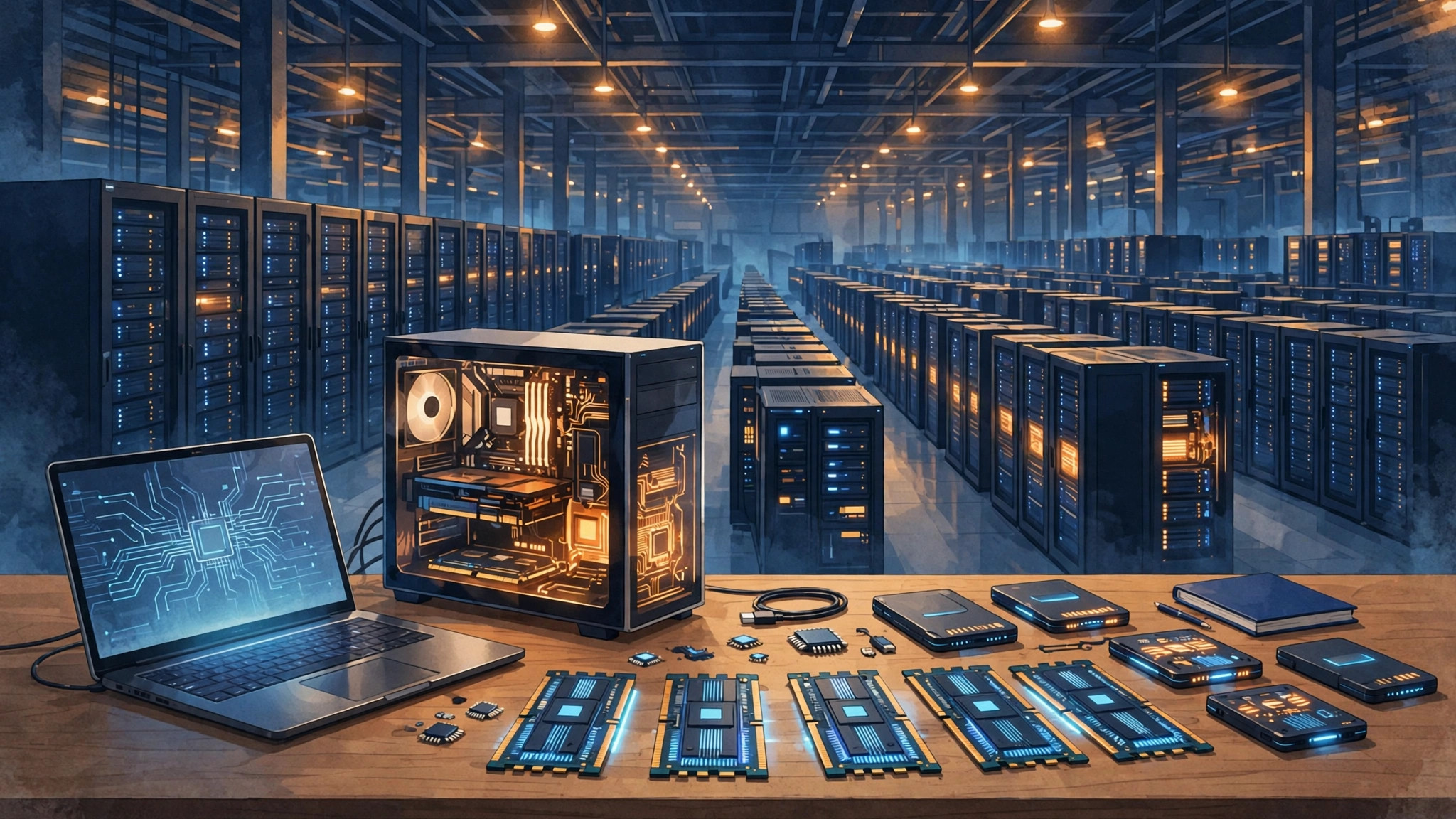
No affiliate links for the hardware in this article — tool and component names are plain text, and no retailer prices are quoted, since prices change frequently. Check the retailer's live page before buying. The featured image is an original AI-generated illustration, not a photograph.
Sources: Reuters — Samsung posts record profit in Q3 on AI chip boom · TrendForce Q4 2026 memory forecast, via Pandromeda summary · TrendForce notebook outlook, via 9to5Mac
FAQs
Is the memory shortage real, or just marketing to raise prices?
The tightness is real and documented: Samsung's memory revenue rose 427% year on year, its 2027 HBM supply is already sold out at agreed prices, and both Samsung and SK Hynix say the shortage deepens in 2027. What is marketing is the leap from those facts to claims that every product price will double — that part is forecast, not fact, and it varies by product.
Should I buy RAM now or wait?
If you are building a PC or buying a laptop in the next few months anyway, buying the RAM configuration you need now is the safer move, because DRAM is the tighter market and forecasts point to further contract-price rises in Q4 2026. If you have no purchase planned, there is no reason to panic-buy: memory cycles have turned sharply before, and waiting costs nothing if you do not need the upgrade.
Will SSD prices follow RAM prices up?
Not necessarily. SSDs use NAND flash, a different market from DRAM. TrendForce forecasts NAND contract prices up 15–20% in Q4 2026, but also expects NAND supply constraints to ease in the second half of 2027 as new capacity comes online. So SSDs face near-term pressure but have a clearer path to relief than RAM.
Why are AI data centres blamed for my laptop costing more?
Because they buy the same underlying product. AI accelerators use high-bandwidth memory (HBM), a stacked form of DRAM, and server DRAM for the systems around them. Chipmakers earn far more per wafer from HBM and server memory than from consumer memory, so wafer capacity shifts toward data centres first — leaving less, at higher prices, for PCs and phones.
Do contract prices mean shop prices will rise by the same percentage?
No. Contract prices are what big buyers like PC makers pay chipmakers. Retail prices move later, unevenly, and are also affected by inventory, competition, tariffs and how much of a price rise a brand absorbs versus passes on. A 10–15% contract rise does not translate into a 10–15% rise on every product on a shelf.
Could the shortage end suddenly?
It has happened before: memory prices crashed in late 2018 after a buying boom, and again after the pandemic-era surge. New fab capacity, weaker consumer demand or a slowdown in data-centre spending could all loosen the market. Nothing in current forecasts points to relief before late 2027, but forecasts are not guarantees, and the cycle's history argues against treating today's prices as permanent.
Written by
AI Trends Daily Team
The AI Trends Daily team researches AI and technology daily, then explains it in plain English — no jargon, no hype, just what matters.
Related Articles
 AI
NVIDIA Nemotron 3 Ultra Explained: The 550B Open-Weight Model Built for AI Agents
Nemotron 3 Ultra is NVIDIA's largest open-weight model: 550B parameters, a 1M-token context window and agent-first design. What NVIDIA claims, what independent scores say, and the hardware catch.
October 28, 2026
 AI
OpenAI GPT-6.1 Terra Explained: Half-Price Computer Use
GPT-6.1 Terra is OpenAI's new mid-tier model for computer use in Work and Codex at $1/$5 per million tokens — half of Sol. Who should use it, and who shouldn't?
October 27, 2026
 AI
Claude Duet Explained 2026: AI That Comes to You
Claude Duet is Anthropic's proactive agent that briefs you each morning and works in the background. Who can join, what it does, and where its controls stop.
October 26, 2026