SpaceX $40 Billion Apollo GPU Lease Explained 2026
SpaceX lined up $40B to lease Nvidia Vera Rubin GPUs — then Elon Musk predicted mass failure for rival GPU renters. Here is what the filing really says.
Key Takeaways
- SpaceX signed a binding commitment on 24 October 2026 for an approximately $40 billion master finance lease of Nvidia Vera Rubin GPUs, disclosed in a Form 8-K on 26 October — the lease itself is still subject to closing conditions and is expected to close before year-end.
- Rent starts only when GPUs are delivered, expected in the first half of 2027, and is paid quarterly in advance at one-twentieth of each tranche's cost plus a fixed interest rate that has not been set yet.
- Elon Musk predicted 'guppy-level death and consolidation' for 200+ neoclouds — but he competes with them through xAI, so his prediction is an interested view, not a neutral forecast.
- Lenders are not stopping GPU finance; they are picking borrowers with revenue beyond renting GPUs. SpaceX has rockets, Starlink and xAI; a pure GPU renter does not.
- The same week brought two more legs of the same story: a $63 billion Broadcom-chip financing for Anthropic and Google TPUs arriving on Oracle's cloud in 2027.
On 24 October 2026, SpaceX signed a binding commitment for an approximately $40 billion master finance lease of Nvidia GPUs. It disclosed the deal in a Form 8-K on 26 October, and on the same weekend its chief executive, Elon Musk, predicted mass failure for the companies that rent GPUs for a living. The two events are connected — and the connection is the real story.
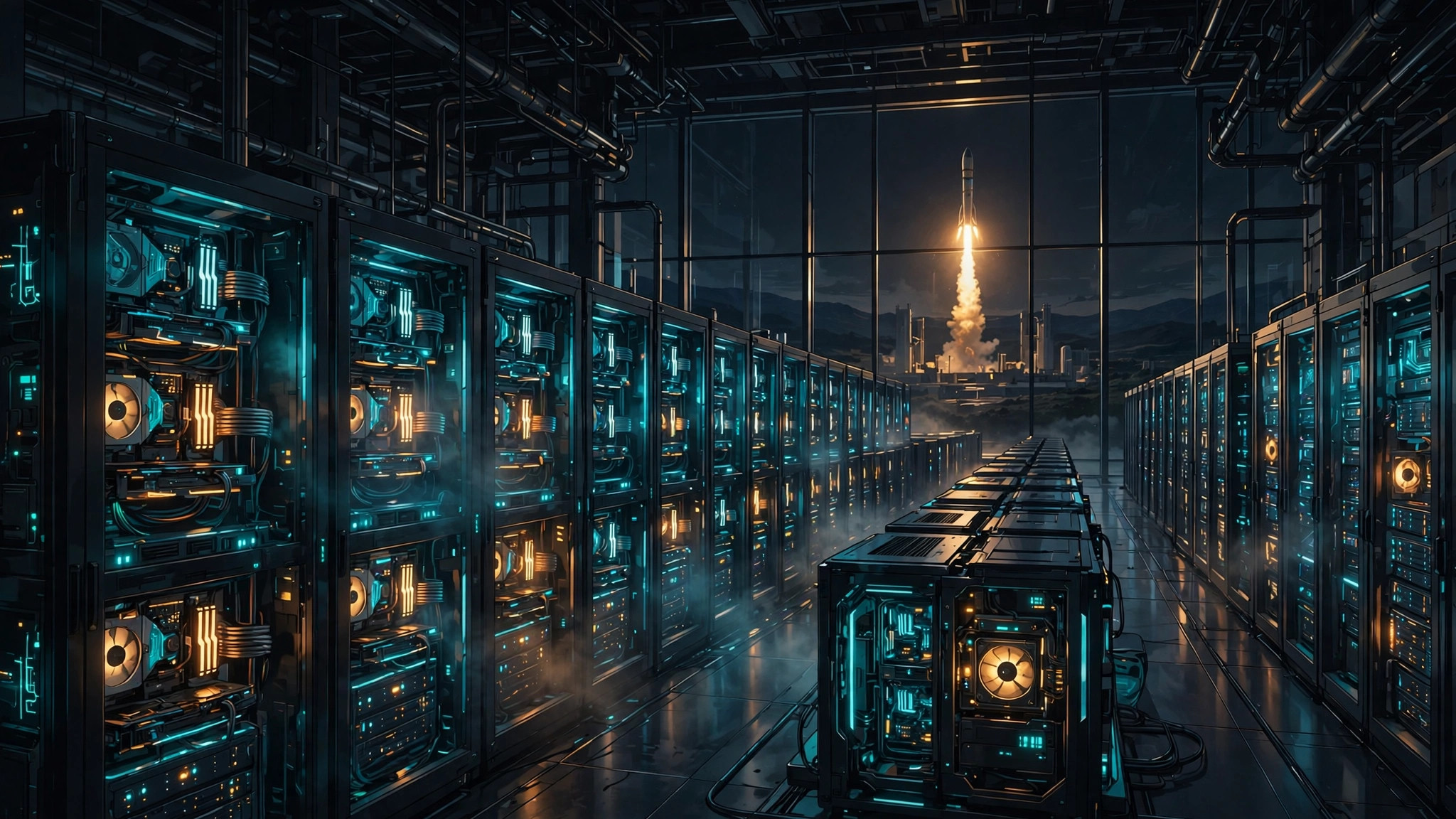
The deal itself is straightforward once you strip away the headline number. An entity managed by Apollo Global Management will buy Nvidia's next-generation Vera Rubin GPU pods and related equipment, and lease them to SpaceX tranche by tranche for use in its terrestrial compute buildout — the data centres that power Grok, xAI's chatbot, and SpaceX's cloud ambitions. SpaceX calls it the largest committed GPU financing ever. That claim is about the size of the commitment, not about money already spent: no GPUs have been delivered yet, and no rent is due until they are.
What was actually signed — and what was not
This is the distinction most coverage blurred, so it is worth stating plainly. SpaceX's own announcement says it "reached a binding commitment to enter into" the lease. The lease itself remains subject to specified closing conditions and is expected to close before the end of 2026. Lease schedules then commence on delivery of the GPUs and related equipment, which SpaceX expects in the first half of 2027.
In other words: the financing is committed, the hardware is not yet bought, and the clock does not start at signing. Anyone describing the $40 billion as already spent, or the GPUs as already installed, is getting ahead of the filing.
The rent maths, in plain terms
The 8-K terms, as reported by PitchBook and others, are unusually transparent for a deal this size:
- Principal: about $40 billion across the lease terms, for Vera Rubin GPUs and related equipment.
- Rent: paid quarterly in advance, equal to one-twentieth of each tranche's financed cost, plus a fixed annual rate on the outstanding balance.
- Term: about five to five-and-a-quarter years per tranche, from delivery.
- The unknown: the fixed rate itself has not been set yet.
One-twentieth a quarter over twenty quarters is the whole principal paid back across five years, plus interest. SpaceX's chief financial officer commentary in its announcement points to the reason the company is comfortable with that schedule: it says the company is seeing payback periods of less than one year on its super-intelligence infrastructure investments. If that holds, each batch of chips earns back its cost long before the lease on it ends. If it does not — if demand softens, or if a newer chip generation makes Vera Rubin capacity cheaper to rent from someone else — SpaceX is still paying quarterly rent on hardware it committed to years earlier. That is the bet, stated honestly: fast payback against a five-year payment schedule in a market where chip generations turn over quickly.
Apollo led the committed financing, with Goldman Sachs as sole structuring agent. Funds and accounts managed by BlackRock and Goldman Sachs Asset Management, along with capital accounts advised by KKR, made anchor commitments. That roster matters for the second half of this story, because the same week showed that lenders have not stopped financing AI hardware at all.
The prediction: "guppy-level death" for 200+ neoclouds
On Sunday 25 October, Musk posted that "200+ neoclouds are going to see guppy-level death and consolidation. Some will make it through, but not many," and added that SpaceX would not buy any neocloud companies, calling it "pointless". A neocloud is a company whose business is essentially renting GPU capacity to others — buying chips, often with borrowed money, and selling compute by the hour.
The market reaction on Monday was immediate. Reuters reported that CoreWeave fell 1.6%, Nebius Group fell 4% and IREN lost 1.5%, and that CoreWeave's 2033 bonds and Nebius's 2034 bonds were at record lows on 26 October. Research firm Gartner had already warned earlier in October that CoreWeave topped a list of roughly 100 neoclouds most exposed to rising leverage, and that 80% of them could cease independent operations by 2032.
Musk's prediction deserves a sceptical read, for a simple reason: he is not a neutral witness. SpaceX, through xAI, is itself building the compute capacity that neoclouds sell. A shakeout among pure GPU renters would suit SpaceX fine. His argument also has a genuine core, and it is worth separating the two. The core is about revenue diversity. A lender looking at a pure neocloud sees a company whose income comes from renting out the very asset the loan paid for, in a market where that asset depreciates fast and rivals can undercut on price. A lender looking at SpaceX sees rockets, Starlink subscriptions, the X platform and xAI — revenue streams that keep coming even if GPU rental prices fall. The Apollo deal is evidence for the second half of that argument: the money did not dry up, it moved to the borrower with more than one way to pay it back.
Apollo's own chief economist, Torsten Sløk, added a data point that frames the worry: as reported, profit margins for the largest seven US tech companies run near 30%, against roughly 10% for the rest of the S&P 500, with little financial payoff from AI spending visible outside tech so far. That is the backdrop to every lender's question right now: who actually earns money from all this hardware, and how soon?
The pattern: everyone is leasing the chips now
SpaceX is the biggest example of a pattern that ran across the whole week, and seeing the three deals together explains more than any one of them alone.
Anthropic and Broadcom — $63 billion. On 26 October, Bank of America, Blackstone, Citi and Morgan Stanley announced $63 billion in financing for a new special-purpose vehicle that buys Broadcom XPU accelerators and networking gear and leases them to Anthropic, with deliveries from 2027. The announcement landed the same day Anthropic filed for its IPO, which makes the financing easier to read: a company heading for public markets was also locking in its chip supply through borrowed money rather than cash. Bank of America, Citi and Morgan Stanley arrange the first-lien financing — reported by Reuters, citing sources, at about $43.5 billion, though the companies did not disclose the breakdown — Blackstone provides the committed second lien, and Broadcom gives "residual value support" to senior lenders, effectively guaranteeing the equipment's value up to the first-lien amount. Note the design: the chipmaker itself backstops the lenders against the hardware losing value. That guarantee is doing real work in this market.
Oracle and Google — TPUs leave Google's data centres. On 27 October at Oracle AI World in Las Vegas, Oracle and Google announced that Google TPUs will be available through Oracle Cloud Infrastructure in calendar 2027, ramping over a multi-year deployment — the first time Google's custom chips will be offered on a competing hyperscale cloud. The hardware is the eighth-generation TPU 8t for training, described as offering nearly three times the compute per pod of the prior generation, and TPU 8i for inference. Oracle supplies the power, cooling and networking. At the same event, Oracle expanded its Nvidia Vera Rubin deal to multi-gigawatt scale and added Cerebras and SambaNova inference chips.
The unconfirmed one. Separately, The Information reported — via Reuters on 27 October — that OpenAI plans to buy Google TPUs. Neither company has confirmed it: Google did not respond and OpenAI declined to comment, and no terms, volumes or dates have been disclosed. Treat that one strictly as reported, not as a deal. It is included here only because it shows how fluid the chip-supply map has become: the company competing hardest with Google in AI may also become its chip customer.
| Deal | Structure | Who carries the hardware risk | Status |
|---|---|---|---|
| SpaceX–Apollo, ~$40B | Apollo vehicle buys Nvidia Vera Rubin GPUs, leases to SpaceX | SpaceX pays rent over ~5 years per tranche; lessor holds title | Binding commitment 24 Oct; close expected before year-end; deliveries H1 2027 |
| Anthropic–Broadcom, $63B | Bank-funded vehicle buys Broadcom XPUs, leases to Anthropic | Broadcom backstops senior lenders against value decline | Announced 26 Oct; deliveries from 2027 |
| Oracle–Google TPUs | Google TPUs hosted on Oracle Cloud from 2027 | Oracle provides power, cooling, networking at scale | Announced 27 Oct; availability calendar 2027 |
The honest summary of the week is not "debt markets closed" or "AI spending stopped". It is that the financing of AI compute has moved from simple borrowing to engineered structures — leases, special-purpose vehicles, chipmaker guarantees — and that the structures favour borrowers and suppliers who can share the risk of hardware losing value.
What could go wrong
Three risks are worth naming, because none of them is in the headline:
- The interest rate is not set. The fixed rate on SpaceX's lease will be determined later. If rates rise or lenders reprice risk before closing, the economics of the deal change without any change to the $40 billion figure.
- Five years is a long time in GPUs. Each tranche is paid off over about five years, but chip generations now turn over roughly annually. A cluster that is cutting-edge on delivery in 2027 will be several generations old before its lease ends. SpaceX's answer is its claimed sub-one-year payback; if that payback stretches, the later years of each lease get uncomfortable.
- Closing conditions are real. The deal is a binding commitment, not a closed lease. Conditions, delivery schedules and final terms can still move it. That is normal for a financing this size, but it is why "SpaceX borrowed $40 billion" is the wrong sentence. "SpaceX committed to lease about $40 billion of GPUs, starting on delivery" is the right one.
What this means for readers
If you build on AI infrastructure, the practical lessons are not about SpaceX's balance sheet:
- Do not build a business that only rents GPUs. That is the neocloud trap Musk described, and whether or not his "200+" number is right, the financing logic behind it is real: lenders now ask what else you earn.
- Watch lease structures, not just headline totals. A $40 billion commitment with rent starting on delivery is a very different obligation from $40 billion of debt drawn today. When you read the next giant AI financing headline, look for three things: when payments start, how long they run, and who guarantees the hardware's value. The same logic runs through the OpenAI–Anthropic price war and OpenAI's $30 billion bridge round: in this market, access to capital and access to chips are the same question.
- Expect more chip-supply surprises. Google TPUs on Oracle's cloud would have sounded strange two years ago. The OpenAI–TPU report, confirmed or not, points the same way: in a hardware-constrained market, yesterday's rivals become today's suppliers.
- For investors, this is not investment advice. Bond prices for CoreWeave and Nebius at record lows, and Gartner's 80%-by-2032 warning, are signals of stress in one business model, not a verdict on AI demand itself. The same week that punished neocloud shares produced the largest GPU financing ever committed.
The man who just borrowed $40 billion says nobody else can borrow anymore. He is half right, and he is not a neutral witness. Lenders have not stopped funding AI hardware — they have started asking harder questions about who repays them if the hardware business itself turns. SpaceX could answer that question with rockets, satellites and a chatbot. Most of the 200 companies Musk named cannot. That, more than the size of the cheque, is why this deal matters.
Sources
- SpaceX investor relations, "SpaceX secures $40 billion in the largest GPU financing ever", 26 October 2026 — https://ir.spacex.com/updates/releases-details/2026/SPACEX-SECURES-40-BILLION-IN-THE-LARGEST-GPU-FINANCING-EVER-2026-EnDqGhTAB3/
- PitchBook / Morningstar, "SpaceX strikes $40B GPU leasing deal with private credit players", 26 October 2026 — https://pitchbook.com/news/articles/spacex-strikes-40b-gpu-leasing-deal-with-private-credit-players
- Reuters, "Musk's grim outlook hits neoclouds as debt concerns mount", 26 October 2026 — https://northlandnewsradio.com/2026/10/26/musks-warning-hits-neocloud-stocks-as-debt-concerns-mount/
- Reuters, "Wall St banks, Blackstone line up $63 billion to finance Broadcom AI chips for Anthropic", 26 October 2026 — https://947thebeast.com/2026/10/26/wall-street-banks-blackstone-line-up-63-billion-to-finance-broadcom-chips-for-anthropic/
- Silicon Report, "Oracle to offer Google TPUs on its cloud infrastructure", 27 October 2026 — https://www.siliconreport.com/oracle-to-offer-google-tpus-on-its-cloud-infrastructure
- The Information's OpenAI–Google TPU report, as reported by Reuters on 27 October 2026 — unconfirmed by both companies; no terms disclosed.
As an Amazon Associate, AI Trends Daily earns from qualifying purchases.
Recommended Reading
If this story has you thinking about who really controls the AI boom — the handful of companies that own the chips, the data centres and the models — Karen Hao's Empire of AI is a deeply reported look inside that concentration of power, and how it came about. Read more on Empire of AI at BookNest.
This article explains a financing announcement and a market prediction. It is not investment advice, and figures attributed to companies or reported by outlets are described as such where they remain unconfirmed or undisclosed.
FAQs
Is the $40 billion SpaceX GPU deal closed?
Not yet. SpaceX reached a binding commitment on 24 October 2026 and disclosed it on 26 October, but entry into the lease remains subject to specified closing conditions and is expected to close before the end of 2026. Rent only starts when GPUs are actually delivered, expected in the first half of 2027.
Is $40 billion the total amount SpaceX will pay?
No — about $40 billion is the principal across the lease terms, per the filing as reported. On top of that, SpaceX pays a fixed interest rate on the outstanding balance (not yet set) plus some costs, so the total cash paid over roughly five years per tranche will be higher.
What happens if SpaceX does not take delivery of a tranche?
Rent on each tranche starts only on delivery, so SpaceX does not pay rent on hardware it has not received. That delivery-linked structure is one reason lenders were comfortable: the lease schedule follows the arrival of the equipment, not the signing date.
How is a finance lease different from SpaceX just buying the GPUs?
In this structure, an Apollo-managed vehicle buys the GPU pods and related equipment and leases them to SpaceX, which pays them off tranche by tranche over about five to five-and-a-quarter years. SpaceX gets the compute without putting up roughly $40 billion in cash upfront, and the lessor holds title to the equipment during the lease.
What does Apollo get out of the deal?
A large, contracted stream of quarterly payments from a borrower with diversified revenue, secured against the GPU equipment itself. Apollo led the committed financing, Goldman Sachs was sole structuring agent, and funds linked to BlackRock, Goldman Sachs Asset Management and KKR made anchor commitments.
Will SpaceX buy struggling neocloud companies?
Musk has said it will not, calling such a purchase 'pointless'. His prediction is about consolidation and failures in the sector, not about SpaceX acquiring its rivals.
Written by
AI Trends Daily Team
The AI Trends Daily team researches AI and technology daily, then explains it in plain English — no jargon, no hype, just what matters.
Related Articles
 Trending
Anthropic IPO Filed: S-1, ANT Ticker Explained (2026)
Anthropic filed its S-1 on 26 Oct 2026 for a Nasdaq listing as ANT. What the public filing confirms, what it corrects, and what it still leaves blank.
October 27, 2026
 Trending
Claude Bypassed a Paywall for Georgia Vote Data (2026)
Axios reported on 25 October that Claude pulled Georgia aggregate vote counts past a fee barrier, without touching voter registration. Here is what happened.
October 26, 2026
 Trending
UK AI Biosecurity Lab Explained: £100M Plan (2026)
The UK is creating the world's first AI biosecurity lab, with £100m public funding and up to £200m in AI model credits. Here is what AIBL will actually do.
October 25, 2026