Amazon, Intel Q3 2026 Earnings: AWS Grew, Stocks Fell
AWS grew 39% and Intel's data-centre sales jumped 78%, yet both stocks fell after hours on 29 October. Why Q3 2026 guidance, not results, moved markets.
Key Takeaways
- Amazon's AWS grew 39% to $46.0B — its fastest in nearly five years — yet shares fell after hours, because headline sales and earnings missed expectations and 2026 cash spending is running at about $220B.
- Intel beat on profit, with data-centre and AI revenue up 78% to $7.3B, yet shares fell harder, because its Q4 guidance of $15–16B fell well short of the roughly $17B analysts expected.
- Amazon's net income dip is mostly a base effect: Q3 2025 included $9.5B of pre-tax gains on its Anthropic investment, while operating income actually jumped to $28.1B.
- Intel's warning is about the next quarter, not the last one: memory and substrate shortages plus the October explosion at its Fab 28 plant in Israel are squeezing PC supply and margins.
- SanDisk's fiscal Q1 2027 revenue jumped 378% to $11.03B with an 85% gross margin — the other side of the same memory market that is now hurting PC buyers.
Yesterday it was Alphabet versus Microsoft. Last night it was Amazon and Intel. The pattern is now unmistakable, and it is worth stating plainly before the numbers: in this earnings season, investors are not buying the quarter. They are buying next year — and punishing anything that makes next year look more expensive or more uncertain.
Both companies reported after the US market closed on 29 October 2026. Both had genuinely strong parts to their reports. Both saw their shares fall after hours — Amazon by roughly 6–11% depending on the print and timing, Intel by roughly 17–21% on the same basis. The reasons are different, and the difference is the whole story.
Amazon: a record margin, a $220 billion bill
Start with the headline numbers from Amazon's own release, for the quarter ended 30 September 2026. Net sales rose 12% to $201.9 billion, just below the roughly $202.2–$202.3 billion analysts expected. Operating income jumped to $28.1 billion from $17.4 billion a year earlier, giving Amazon a 13.9% operating margin — the highest in its history. Earnings per share came in at $1.89, below the roughly $1.96–$1.97 analysts had expected.
That last line needs context, because it looks worse than it is. Net income fell to $20.7 billion from $21.2 billion a year earlier, but Amazon says the decline is driven primarily by $9.5 billion of pre-tax gains in the third quarter of 2025 from its investment in Anthropic. Strip out that one-off comparison and the operating business improved sharply: North America operating income rose to $8.7 billion from $4.8 billion, and AWS operating income rose to $17.8 billion from $11.4 billion.
AWS is the star of the report. Segment sales rose 39% year on year to $46.0 billion — 39.3% on Amazon's precise figure — the fastest growth in nearly five years, taking the cloud unit to a $184 billion annualised revenue run rate. Chief executive Andy Jassy said on the call that AWS has a contracted backlog of $578 billion, more than double a year earlier, and projected AWS revenue growth above 40% in both 2027 and 2028. Those 2027 and 2028 figures are management projections, not results, and they should be read that way.
So why did the shares fall? Three reasons, in order of importance. First, the headline miss: sales and earnings both came in below expectations, even if only narrowly on sales. Second, the cash bill. Amazon confirmed it still expects approximately $220 billion of cash capital expenditure for 2026, and Jassy said 2027 spending would be "meaningfully more". Trailing twelve-month free cash flow swung to a $42.4 billion outflow, from a $14.8 billion inflow a year earlier, driven primarily by a $94.8 billion year-on-year increase in purchases of property and equipment — mostly AI investment, in Amazon's own words. Third, the fourth-quarter guidance was solid but not exciting: net sales of $240–$247 billion and operating income of $28.5–$33.5 billion, roughly in line with expectations, with no upside surprise to offset the spending plan.
None of this means AWS demand is weakening. A 39% growth rate at $46 billion of quarterly revenue is the opposite of weakening. It means investors are now asking a harder question than "is AI demand real?" — they are asking "how much cash does meeting that demand consume before it pays back?" That is the same question that split Alphabet and Microsoft the night before, and Amazon's answer this quarter was: a lot.
Intel: the best data-centre quarter in 15 years — and a warning
Intel's report is the mirror image. Where Amazon missed narrowly on the headline lines, Intel beat on profit. Revenue rose 21% year on year to $16.5 billion, and non-GAAP earnings per share reached $0.52, well ahead of the roughly $0.40–$0.41 analysts expected. Non-GAAP gross margin hit 44.1%.
The driver was Data Center and AI, or DCAI. Revenue there reached $7.3 billion, up 78% year on year — the segment's strongest growth in 15 years, according to chief financial officer David Zinsner — with operating profit of $3.0 billion. Intel credited AI infrastructure demand, particularly server CPUs for inference and agentic AI workloads, and improved server CPU supply. Foundry revenue rose 58% to $6.7 billion, including internal sales. The weak spot was the business Intel was built on: Client Computing revenue fell 5% year on year to $8.1 billion, as rising memory prices weighed on PC demand.
Then came the guidance, and the shares fell. Intel guided fourth-quarter revenue to $15–$16 billion, against roughly $17 billion analysts expected, with non-GAAP earnings of $0.25 per share against roughly $0.43 expected, and a non-GAAP gross margin of about 38% — a sharp step down from 44.1%. Two forces explain the gap. The first is the PC market: Intel said PC weakness, compounded by industry-wide memory and substrate shortages, is expected to persist through at least the first half of 2027. The second is specific and sombre: an explosion on 14 October at Intel's Fab 28 plant in Kiryat Gat, Israel, killed two workers, and Intel said the disruption would cost roughly $300 million of fourth-quarter revenue and about 200 basis points of gross margin, with a similar revenue effect in early 2027.
Put together, Intel's story is almost the opposite of Amazon's. Amazon's quarter was slightly soft and its future spending is enormous; Intel's quarter was strong and its near future is constrained by supply. Yet both shares fell, because in both cases the market was pricing the next few quarters, not the one just reported.
SanDisk: the other side of the memory coin
There is a third result from the same night that ties the two stories together, and it is worth a sidebar rather than a footnote. SanDisk reported fiscal first-quarter 2027 results (for the quarter ended 2 October 2026 — note the fiscal label, which is not the calendar quarter) with revenue of $11.03 billion, up 378% year on year, and a GAAP gross margin of 85.0%, up from 29.8% a year earlier. Data-centre revenue reached $4.80 billion, up 61% sequentially, and SanDisk guided fiscal second-quarter revenue to $12.2–$12.6 billion alongside an 8-for-1 stock split.
Read that margin carefully, because it is the other side of Intel's PC warning. SanDisk's revenue rose $8.7 billion year on year while its cost of revenue rose by only about $32 million — a pattern that points to prices and product mix doing much of the work, not simply selling more units. On the earnings call, management attributed roughly 60% of the sequential revenue increase to volume and 40% to price increases, which measures a different window than the year-on-year cost comparison; the honest summary is that both price and demand are contributing, and the mix between them is not fully disclosed. What is not in doubt is the direction: memory is expensive, memory suppliers are extraordinarily profitable right now, and PC buyers are the ones feeling it. Our memory shortage guide from yesterday explains what that means for buying decisions — and Intel's warning suggests its afternoon follow-up, on when PCs get cheaper, will not be good news for buyers hoping for relief soon.
What this means for readers, not just shareholders
Strip out the share prices and three practical lessons remain.
First, the AI build-out is not slowing, but its financing is now the story. AWS at 39%, Google Cloud doubling, Azure at 48%, Intel's data-centre business up 78% — demand is not the question. Cash is. Every one of these companies is spending at a pace that would have been unthinkable three years ago, and the market is now grading them on how that spending converts into cash, not just revenue.
Second, the memory shortage is no longer a forecast — it is in reported results. It is lifting SanDisk's margins to 85%, cutting Intel's PC business, and squeezing Intel's fourth-quarter margin guidance. Anyone planning a PC, laptop or storage purchase should treat "wait for prices to fall" as a 2027-or-later hope, not a near-term plan, and buy for the life of the device rather than timing a dip nobody can date.
Third, guidance now matters more than results. Amazon missed narrowly and fell; Intel beat clearly and fell harder. If you only read the headline "beat" or "miss" on earnings night, you will misunderstand both reactions. The useful habit is to read the quarter and the forecast side by side — which is why the table below, not the share move, is the part of this article worth keeping.
| Measure | Amazon Q3 2026 | Intel Q3 2026 |
|---|---|---|
| Revenue | $201.9B, +12% | $16.5B, +21% |
| Star segment | AWS $46.0B, +39% | Data Center & AI $7.3B, +78% |
| Weak spot | Headline EPS $1.89, below ~$1.96–$1.97 expected | Client Computing $8.1B, −5% |
| Operating income / margin | $28.1B, 13.9% margin (record) | DCAI operating profit $3.0B; non-GAAP gross margin 44.1% |
| Cash signal | Trailing free cash flow −$42.4B; ~$220B capex in 2026 | Q4 gross margin guided to ~38% |
| Next-quarter guidance | Q4 sales $240–$247B (roughly in line) | Q4 revenue $15–$16B (well below ~$17B expected) |
| After-hours share move | Down roughly 6–11% (prints vary) | Down roughly 17–21% (prints vary) |
Yesterday's Alphabet versus Microsoft earnings breakdown showed the same split — one company keeping its cash, one burning it — and the market choosing accordingly. Amazon and Intel extend that story rather than changing it: the AI boom is real, the demand is real, and the bill has arrived. What happens next depends less on whether AI keeps growing and more on whether the companies building it can turn that growth into cash faster than they spend it.
This article explains reported results and market reaction. It is not investment advice.
Recommended Reading
If you want the backstory behind how the AI industry reached this scale of spending, Karen Hao's Empire of AI traces the rise of the companies now dominating it. Read more on Empire of AI at BookNest.
As an Amazon Associate, AI Trends Daily earns from qualifying purchases.
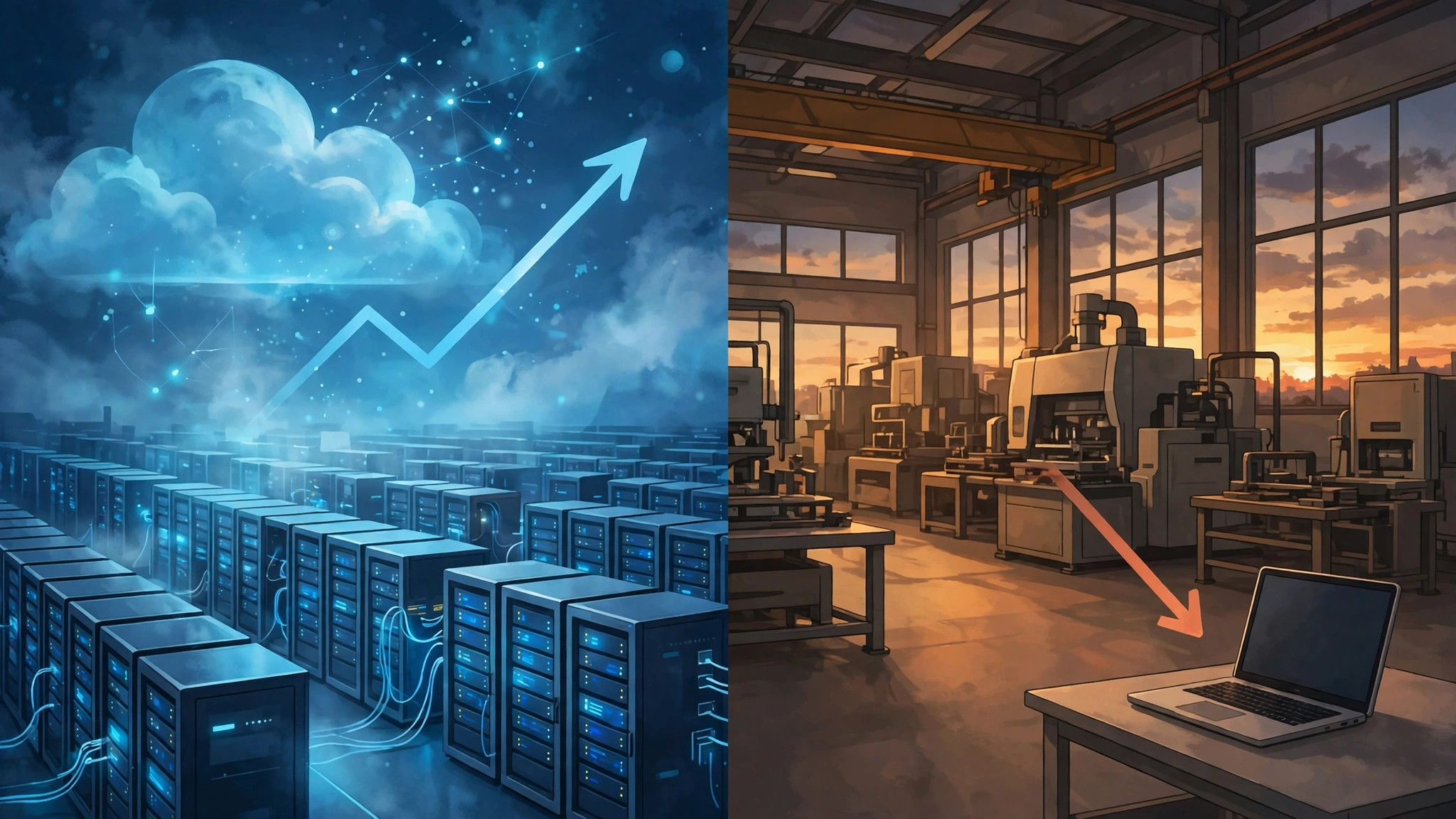
The featured image is an original AI-generated illustration, not a photograph.
Sources: Amazon Q3 2026 earnings release · GeekWire — AWS growth hits 39% · Invezz — Intel stock plunges 17% after weak Q4 forecast · Quantli — Intel posts strong Q3 but issues weak Q4 guidance · Motley Fool — SanDisk revenue up 378%
FAQs
Why did Amazon shares fall if AWS grew 39%?
Because investors price the whole report, not one division. AWS beat expectations, and operating income jumped to $28.1B, but net sales of $201.9B and earnings of $1.89 per share both came in just below analyst expectations. On top of that, Amazon confirmed about $220B of cash capital spending for 2026 and said 2027 spending would be meaningfully higher, while trailing twelve-month free cash flow swung to a $42.4B outflow. The quarter was strong; the cash bill for the AI build-out is what spooked the market.
Why did Intel shares fall if it beat earnings expectations?
Intel's third quarter genuinely beat on profit: non-GAAP earnings of $0.52 per share against roughly $0.40–$0.41 expected, with data-centre and AI revenue up 78%. But its fourth-quarter guidance — revenue of $15–16B and non-GAAP earnings of $0.25 per share — fell well short of expectations of roughly $17B and $0.43. Markets were reacting to the forecast, plus a warning that PC weakness and memory shortages will persist into 2027, not to a miss in the quarter just reported.
Does Amazon's negative free cash flow mean it is losing money?
No. Amazon's operating income rose to $28.1B in the quarter, its highest-ever operating margin at 13.9%, and operating cash flow for the trailing twelve months rose 29% to $168.3B. Free cash flow is what remains after capital spending, and Amazon spent heavily on data centres, AI chips and other infrastructure — enough to push the trailing twelve-month figure to a $42.4B outflow. That is a statement about investment pace, not about whether the business is profitable.
What happened at Intel's Fab 28 plant, and why does it matter?
On 14 October, an explosion at Intel's Fab 28 fabrication facility in Kiryat Gat, Israel, killed two workers. Intel said the disruption would cost roughly $300M of fourth-quarter revenue and about 200 basis points of gross margin, with a similar revenue effect in early 2027. Combined with industry-wide memory and substrate shortages, it is one of the concrete reasons Intel's Q4 outlook is so much weaker than its Q3 result.
Should I buy or sell Amazon or Intel stock on this news?
This article cannot answer that, and you should be wary of any article that claims to. After-hours moves often reverse once analysts and longer-term investors digest the full call, and a single quarter's guidance is only one input. If you follow these companies, track the numbers that actually drove the reaction — AWS growth versus capital spending, Intel's Q4 revenue and margin, and whether memory supply eases — across several quarters rather than reacting to one night's share move.
Written by
AI Trends Daily Team
The AI Trends Daily team researches AI and technology daily, then explains it in plain English — no jargon, no hype, just what matters.
Related Articles
 Trending
Alphabet vs Microsoft Q3 2026 Earnings Explained
Google Cloud doubled and Azure hit $33.17B in Q3 2026, yet Alphabet shares fell while Microsoft's rose. The split verdict comes down to cash, not AI demand.
October 29, 2026
 Trending
SpaceX $40 Billion Apollo GPU Lease Explained 2026
SpaceX lined up $40B to lease Nvidia Vera Rubin GPUs — then Elon Musk predicted mass failure for rival GPU renters. Here is what the filing really says.
October 28, 2026
 Trending
Anthropic IPO Filed: S-1, ANT Ticker Explained (2026)
Anthropic filed its S-1 on 26 Oct 2026 for a Nasdaq listing as ANT. What the public filing confirms, what it corrects, and what it still leaves blank.
October 27, 2026